
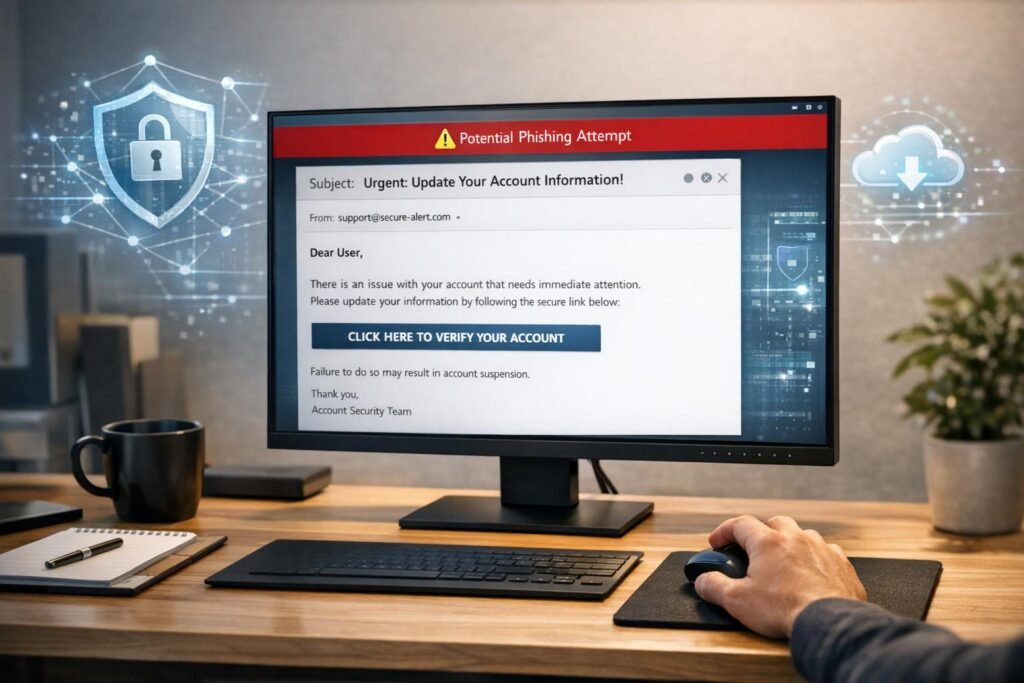
Phishing attacks are growing more sophisticated, with over 3.4 billion phishing emails sent daily and AI-driven campaigns increasing by 1,200%. To combat this, phishing simulation tools are essential for training employees to recognize and avoid these threats. These tools simulate phishing attacks via emails, SMS, voice calls, and even QR codes, offering targeted training to reduce employee susceptibility by up to 70%.
Here are 10 top phishing simulation tools of 2025:
- KnowBe4: Offers 25,000+ templates, AI-based phishing generators, and seamless integration with Microsoft 365 and Google Workspace.
- Proofpoint: Uses real threat intelligence to create realistic scenarios, including email, SMS, and USB-based attacks.
- Cofense PhishMe: Focuses on multi-vector attacks like smishing and vishing, with strong SOC integration.
- Hoxhunt: Gamifies training and dynamically adjusts difficulty based on user performance.
- Infosec IQ: Provides role-specific training and supports over 1,000 templates.
- Gophish: A free, open-source tool for technically skilled teams to create custom phishing simulations.
- Sophos Phish Threat: Integrates with Sophos Central and uses real-time threat intelligence.
- Guardey: Combines simulations with weekly gamified challenges to encourage engagement.
- PhishingBox: Features dynamic templates and automated training via its LMS.
- uPhish by Usecure: Automates simulations and training, focusing on continuous learning.
Quick Comparison
| Tool | Best For | Key Features | Pricing |
|---|---|---|---|
| KnowBe4 | Large organizations | AI-driven templates, deep integrations | $1.30–$3.25/user/month |
| Proofpoint | Compliance-focused teams | Real threat intelligence, multi-vector | ~$18/user/year |
| Cofense PhishMe | SOC teams | Multi-vector, SOC reporting | Quote-based |
| Hoxhunt | Behavioral improvement | Gamification, adaptive difficulty | Quote-based |
| Infosec IQ | Role-specific training | 1,000+ templates, LMS integration | $20/user/year (min $1,500) |
| Gophish | Tech-savvy teams | Open-source, custom simulations | Free |
| Sophos Phish Threat | Sophos ecosystem users | 500+ templates, threat intelligence | Quote-based |
| Guardey | Engagement-focused teams | Gamified challenges, quick setup | Quote-based |
| PhishingBox | SMBs and mid-market | LMS, dynamic templates | $16.50–$31.25/user/year |
| uPhish | Continuous learning | Automated training workflows | Quote-based |
Phishing simulation tools are crucial for building resilience against evolving threats like smishing, vishing, and quishing. Choose one based on your organization’s size, goals, and technical capabilities.
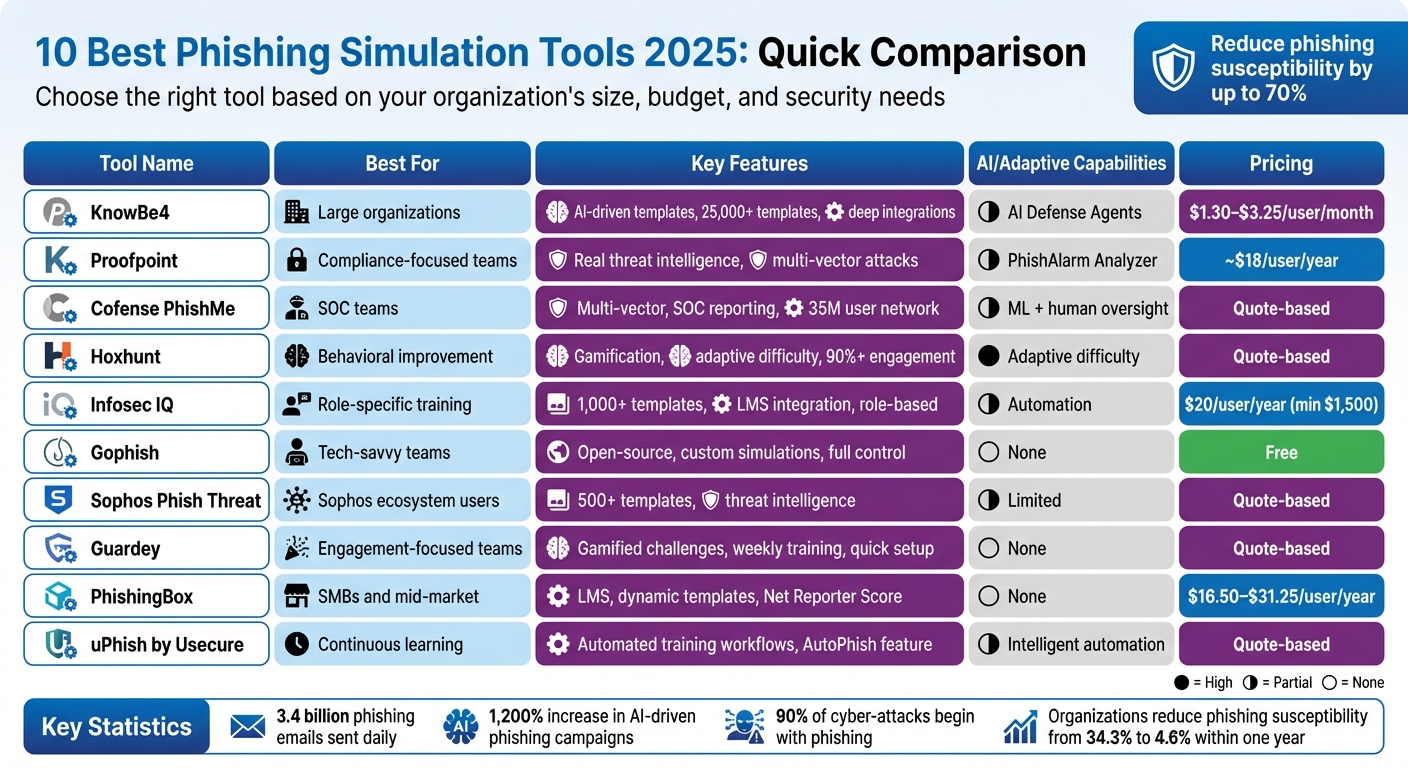
Phishing Simulation Tools Comparison: Features, Pricing & Best Use Cases 2025
Top Phishing Threats to Simulate in 2025
1. KnowBe4
KnowBe4 is a phishing simulation platform trusted by more than 70,000 organizations worldwide. It offers an impressive library of over 25,000 phishing templates, updated monthly to reflect the latest attack trends and events. By spoofing well-known brands like LinkedIn, Amazon, Microsoft Office 365, and Dropbox, the platform creates highly realistic training scenarios. These capabilities, combined with its advanced simulations, AI tools, and seamless integrations, make it a standout option.
Realism of Phishing Simulations
KnowBe4 covers a wide range of attack types, including malicious links, attachments, credential harvesting, and even callback tests. It also incorporates deepfake training to help employees recognize AI-driven social engineering attempts. Administrators can design highly targeted spear-phishing campaigns using custom landing pages that mirror real-world threats.
Research involving 11.9 million users found that the average "Phish-prone Percentage" started at 34.3%. Organizations using KnowBe4 reduced this figure to 18.9% within 90 days and further down to 4.6% after a year. A representative from the Pennsylvania Turnpike shared:
Before KnowBe4, our Phish-prone Percentage was up close to 75%. And now, it stays anywhere between 19 and … 23.5 [%].
AI-Driven Features
AI plays a major role in enhancing KnowBe4’s effectiveness. The platform’s Phishing AI generates fresh phishing templates automatically, keeping simulations dynamic and challenging. Meanwhile, the SmartRisk Agent analyzes user behavior across seven domains and 37 signal categories to create personalized risk scores for individuals, groups, and entire organizations. On top of that, AI Defense Agents use behavior-based intelligence to identify risky actions and trigger automated responses, ensuring simulations stay relevant as employees improve their awareness.
Integration with Existing Tools
KnowBe4 integrates smoothly with platforms like Microsoft 365, Google Workspace, Azure AD, and Active Directory. Its Phish Alert Button, a free feature, lets users report suspicious emails with just one click. This action removes the email from their inbox and sends it to the security team for further review. The data collected feeds directly into workflows via PhishER, streamlining security operations. Additionally, KnowBe4 supports data exports to Power BI and provides a User Event API for creating custom dashboards. Deployment options are flexible, including .EXE files for Outlook, manifest installs for Microsoft 365, and Chrome extensions for Gmail.
Pricing and Scalability
KnowBe4 offers a tiered subscription model with four plans: Silver, Gold, Platinum, and Diamond. Pricing ranges from $1.30 to $3.25 per user per month, depending on the plan and the number of users. It’s designed to scale for organizations of all sizes, from small businesses to large enterprises. On top of that, companies using KnowBe4 can expect a three-year ROI of 276%, with a payback period of less than three months.
2. Proofpoint
Proofpoint leverages real threat intelligence by analyzing billions of messages daily to create thousands of simulation templates. These simulations cover a wide range of attack methods, including email phishing, smishing (SMS phishing), and even physical USB-based attacks, ensuring employees are exposed to the latest threats. This approach results in highly realistic and effective simulation experiences.
Realism of Phishing Simulations
With its People Risk Explorer, Proofpoint pinpoints the most frequently targeted individuals in an organization, helping security teams focus on those most at risk [2, 16]. Administrators can design custom phishing simulations by directly replicating actual phishing emails encountered on their networks. Templates come with embedded links, requests for sensitive information, and compatibility with commonly used file formats. Before running a campaign, users can preview average failure rates – calculated from Proofpoint’s extensive customer data – to determine the level of difficulty. The platform also supports simulation templates in 42 different languages.
AI-Driven Features
The platform’s PhishAlarm Analyzer uses machine learning to evaluate user-reported messages, minimizing the need for manual investigations [15, 16]. Additionally, the Proofpoint Nexus AI system identifies human-targeted threats and evaluates data risks. It also employs adaptive learning, assigning tailored training based on how users interact with simulated or real malicious content. For example, clicking on a phishing link triggers immediate, interactive training.
Integration with Existing Tools
Proofpoint integrates effortlessly with tools like Microsoft 365, Google Workspace, SIEM, SOAR, and LMS systems through APIs and built-in reporting features. User-reported messages are routed directly to its Triage and Vision tools for analyst review and automated threat removal [1, 17, 18]. These integrations make it a flexible solution that fits seamlessly into existing security workflows.
Pricing and Scalability
Proofpoint SAT Standard is priced at approximately $18 per user annually, offering unlimited ThreatSim phishing simulations. Designed for large, compliance-focused organizations, the platform simplifies management with automated user enrollment through Azure AD and Microsoft 365. It has received strong ratings, including 4.5/5 on G2, 4.6/5 on Capterra, and 8.4/10 on TrustRadius [2, 4].
3. Cofense PhishMe
Cofense PhishMe takes a security operations center (SOC)-focused approach, leveraging a global network of 35 million trained users to transform phishing reports into actionable insights. This strategy has enabled organizations to cut risky clicks by 75%.
Realism of Phishing Simulations
The platform goes beyond traditional phishing simulations by mimicking multi-vector attacks like smishing (SMS phishing), vishing (voice phishing), and quishing (QR-code phishing) to reflect the tactics used by actual cybercriminals. Administrators can design campaigns with targeted lures, malicious attachments, and credential-harvesting pages tailored to specific teams or roles. The system’s responsive delivery feature schedules simulations during active email use, training employees to recognize threats when they’re most vulnerable.
"Through working with Cofense I am guaranteed to always be in my employees’ inboxes, to always be bringing them some educational programming, as well as testing of true threats."
- Information Security Awareness Lead, Global Manufacturing Company
These realistic simulations are further enhanced by AI, which sharpens threat detection and response.
AI-Driven Features
Cofense integrates machine learning with human oversight to identify advanced phishing attacks, including those created by AI. This combination minimizes false positives while maintaining strong detection capabilities. The platform’s intelligence network identifies a malicious email every 42 seconds and removes verified threats in under a minute. Simulation templates are continuously updated based on real-world threats observed across its user base.
Integration with Existing Tools
A standout feature of Cofense PhishMe is its PhishMe Reporter button, which works seamlessly with Outlook and Gmail. This tool allows employees to flag suspicious emails with a single click. Reports are automatically routed to Cofense Triage and Vision for analyst review and automated threat removal. The platform also integrates with major systems like SIEM, SOAR, LMS, Microsoft 365, and Active Directory, ensuring SOC teams have access to detailed telemetry and streamlined reporting workflows.
Pricing and Scalability
Cofense PhishMe operates on a quote-based pricing model and is positioned at a premium price tier. Designed for large-scale organizations, it supports multi-language templates and provides analytics tailored for board-level reporting across global teams. It has received ratings of 4.4/5 on G2, 4.7/5 on Capterra, and 9/10 on TrustRadius. Users frequently highlight the Reporter button and SOC integration as key strengths, though some mention a steeper learning curve and higher administrative demands compared to more automated solutions.
4. Hoxhunt
Hoxhunt brings together AI-driven personalization and gamification, boasting engagement rates of over 90%. By dynamically adjusting simulation difficulty based on individual performance, it moves away from generic training approaches that often lead to user fatigue.
Realism of Phishing Simulations
Hoxhunt simulates a variety of multi-vector attacks, including email, Slack, Teams, QR codes (quishing), smishing, and even deepfake-enabled scenarios [4, 21]. These simulations are updated regularly using insights from over 100,000 real-world threats. Instead of relying on traditional "gotcha" methods, Hoxhunt incorporates gamification elements like points, badges, leaderboards, and an optional "Spicy Mode" to provide immediate, bite-sized feedback when users interact with simulated phishing links. This approach reinforces safe behaviors without overwhelming users [4, 23].
In 2024, AES Corporation, a Fortune 500 energy company with over 10,000 employees, saw impressive results after adopting Hoxhunt. The company achieved a 74% engagement rate and reduced failure rates by 79%. Ryan Boulais, VP & CISO at AES, shared:
"Hoxhunt has helped us push our resilience into new territory, with our resilience ratio jumping up by over 500 percent. Hoxhunt has helped us surpass anything our legacy SAT tools could deliver."
AI-Driven Features
Hoxhunt’s AI engine takes personalization to the next level by tailoring the frequency and complexity of simulations to each employee’s performance history and job role [4, 24]. The platform supports over 40 languages through AI-powered localization, ensuring relevance for global teams. Admins can also use generative AI to design phishing simulations that replicate the latest attack techniques [4, 21].
The results speak for themselves: the fastest 10% of users report phishing emails in under 60 seconds, and organizations typically achieve a 60% improvement in behavior within the first year. Qualcomm, for instance, targeted its 1,000 most at-risk employees with Hoxhunt’s adaptive training, leading to a 3.5× drop in failure rates and a 73% overall reduction in susceptibility. These AI capabilities integrate seamlessly with Hoxhunt’s broader toolset, enhancing its effectiveness.
Integration with Existing Tools
Hoxhunt complements its adaptive training by integrating smoothly with platforms like Microsoft 365, Azure AD, Google Workspace, Slack, and Teams. It also works with SOC, SIEM, and SOAR platforms [4, 21]. Its AI-powered SOC feature significantly reduces manual workload, cutting down alert noise by up to 97% by analyzing reported emails and filtering out false positives. For example, Avanade saved more than 900 hours of SOC analyst time each month – equivalent to about five full-time employees – and boosted its resilience ratio by 259%. Greg Petersen, Senior Director of IT Security at Avanade, highlighted:
"What Hoxhunt is doing is bringing the power of human intelligence into the security stack, and not just as a passive last line of defence."
Pricing and Scalability
Hoxhunt operates on a quote-based pricing model, positioning itself as a solution for enterprise-level needs. It has received high user ratings, including 4.8/5 on G2, 4.9/5 on Capterra, and 9.3/10 on TrustRadius. Users appreciate its one-click reporting and gamified engagement, although some note that simulations can occasionally become predictable over time [4, 22, 23].
5. Infosec IQ
Infosec IQ takes a role-focused approach with over 1,000 realistic templates updated weekly. When an employee clicks on a simulated phishing link, they’re redirected to a quick training module that highlights the red flags they missed. This approach turns phishing tests into actionable learning moments. By tailoring simulations to specific roles, Infosec IQ builds on earlier tools to provide targeted, hands-on training.
Realism of Phishing Simulations
The platform creates highly realistic scenarios, covering various attack methods like malicious links, attachments, and credential-harvesting pages. These simulations are customized for different roles – finance teams encounter invoice fraud scenarios, while HR teams face resume-based scams. Additionally, Infosec IQ supports multiple languages, making it suitable for global teams.
A standout example is Amway’s implementation in 2024. Training 18,000 employees with Infosec IQ resulted in a 20% drop in phishing incidents, a 30% decline in malware infections, and an impressive 98% training completion rate. Like similar tools, Infosec IQ doesn’t just test employees – it educates them with immediate, actionable feedback.
Integration with Existing Tools
Infosec IQ goes beyond simulations by seamlessly integrating with existing systems. It works with Azure AD and Office 365 for automated user enrollment, offers SCORM-as-a-service for LMS delivery, and supports API data exports to tools like SIEMs, SOARs, or Power BI. It also includes the PhishNotify button, enabling employees to report suspicious emails directly.
As one Gartner Peer Insights reviewer shared:
"Our account rep is phenomenal – consistently meets us at our maturity level and helps identify paths forward if we encounter an issue".
Pricing and Scalability
Infosec IQ provides flexible options for businesses of all sizes, offering three tiers to address evolving cybersecurity needs. The Standard tier includes unlimited simulations and access to the full template library. Enterprise adds LMS integration and advanced reporting, while Enterprise+ includes hands-on cybersecurity courses. Pricing starts at $20 per user annually, with a minimum contract value of $1,500.
The platform has received strong reviews, with a 4.7 out of 5 rating on Gartner Peer Insights and a 4.5 out of 5 rating on G2. However, some users have noted occasional slowdowns in the administrative tools.
6. Gophish
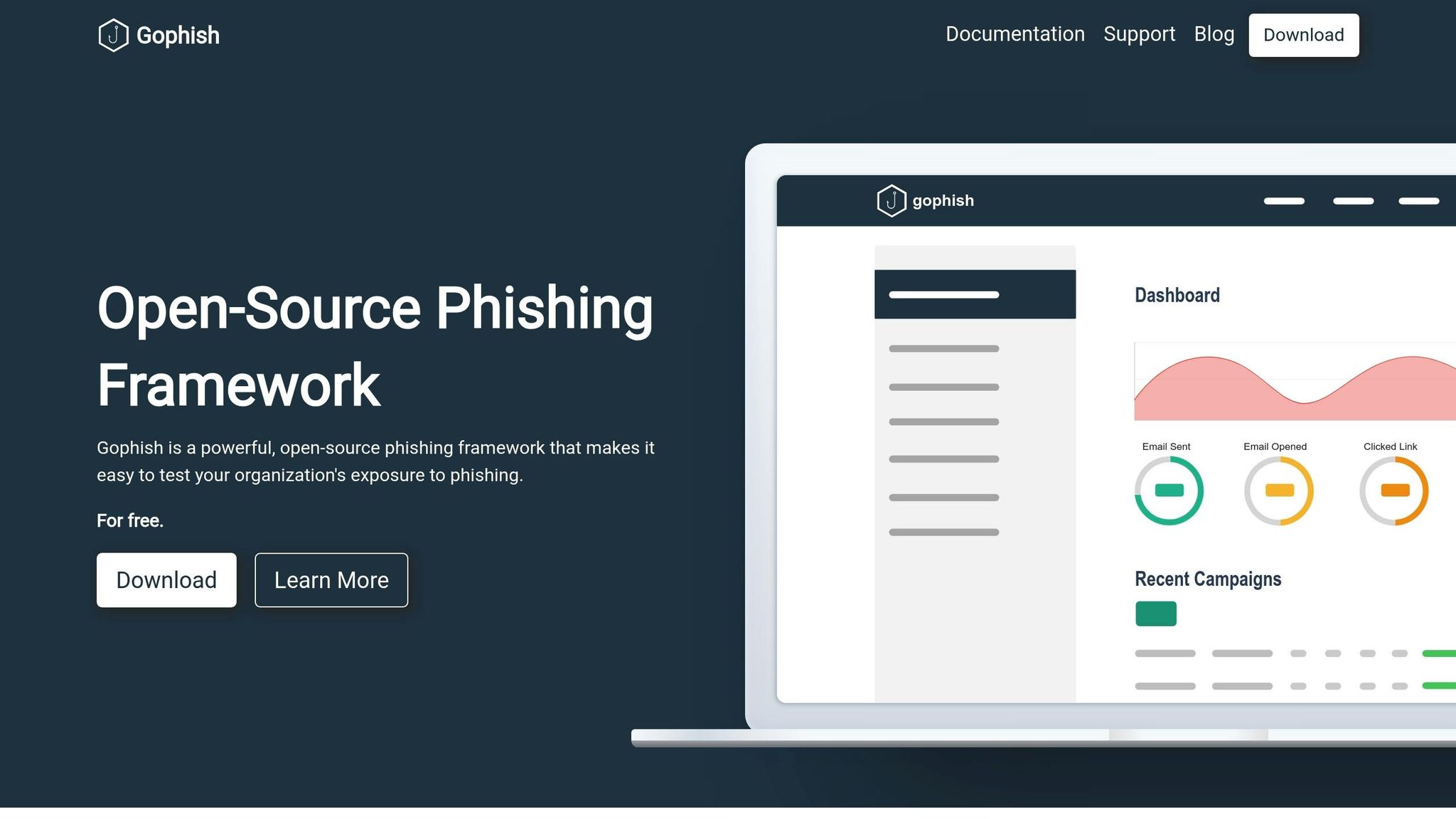
Gophish is a free, open-source phishing simulation framework designed for organizations with technical expertise. It offers full control over simulations, allowing users to create realistic phishing templates by importing existing websites and emails. With a full HTML editor, you can customize simulated emails and landing pages to closely resemble actual phishing threats.
Realism of Phishing Simulations
Gophish provides real-time tracking of user interactions, including email opens, link clicks, and even sensitive data submissions through credential harvesting. This level of detail allows security teams to identify employees who may need extra training. However, Gophish focuses solely on simulation and does not include built-in security awareness training modules. Organizations must either integrate it with third-party training resources or create their own content.
Integration with Existing Tools
Gophish is built on a REST API and includes a Python client, making it easy to integrate with existing security systems and automation workflows. It’s compatible with Windows, macOS, and Linux platforms. However, setting up a Gophish server, particularly on AWS, can be challenging. For example, a Guardey review highlighted the effort required to whitelist the sending domain to prevent Gmail from flagging simulated emails as spam. To ensure emails reach employees, organizations should proactively whitelist their Gophish sending domain.
Pricing and Scalability
Gophish offers flexible pricing options to suit different needs. The open-source version is completely free, while the managed GoPhish Cloud on Azure costs about $0.24 per vCPU/hour, translating to roughly $350 per month. This managed option supports unlimited users and campaigns, offering 50–70% cost savings. It’s designed to scale from 50 to over 10,000 employees and includes features like Azure AD authentication, LDAP sync, and webhook notifications. On the other hand, the self-hosted version demands significant technical expertise for server management and email configuration.
sbb-itb-760dc80
7. Sophos Phish Threat
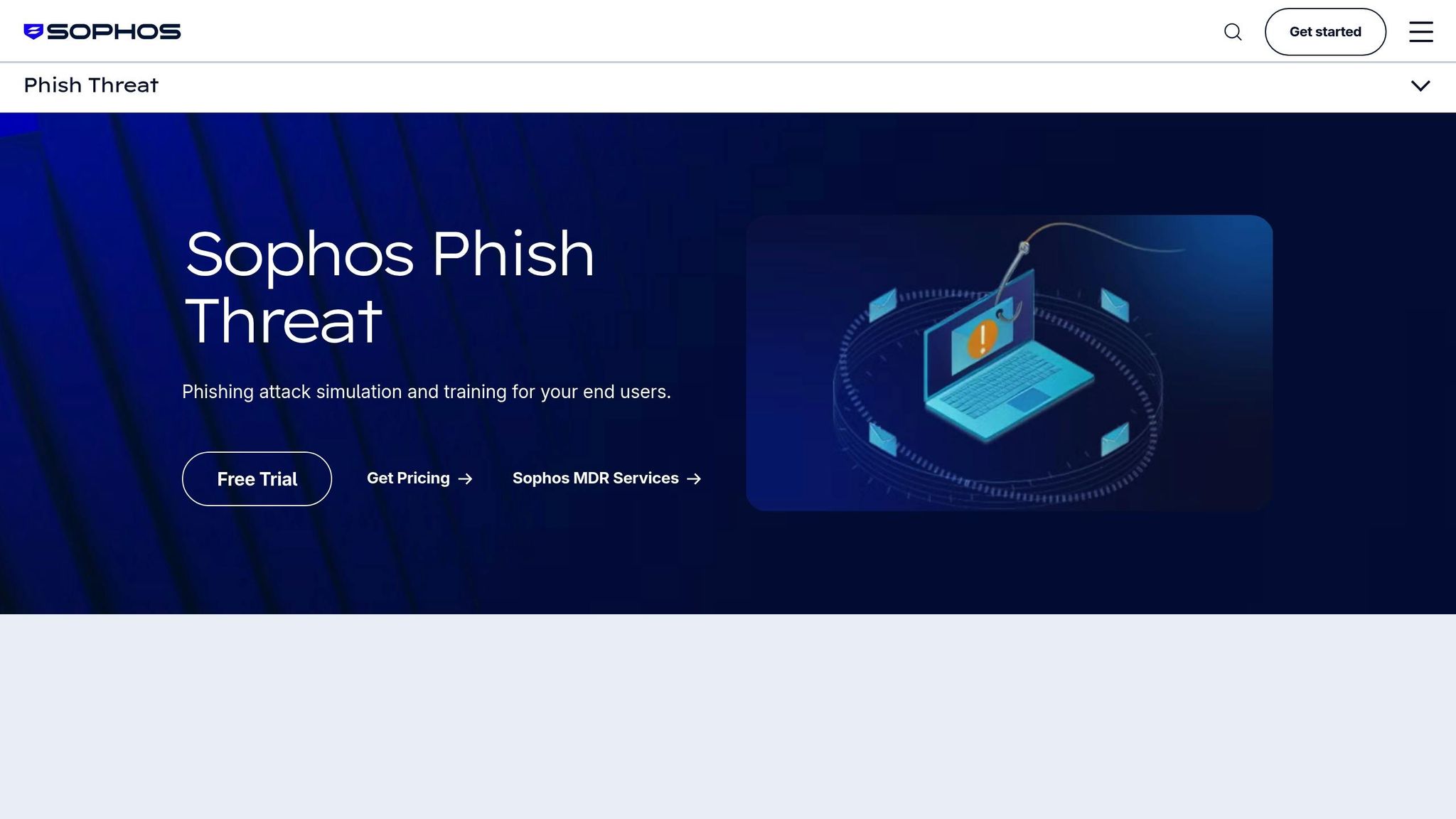
Sophos Phish Threat stands out by utilizing real-time threat intelligence. Powered by SophosLabs‘ global network, it monitors millions of emails, URLs, and files every day to create simulation templates that reflect the latest attack methods. This ensures the simulations are highly realistic and relevant.
Realism of Phishing Simulations
The platform offers over 500 customizable templates, catering to all skill levels – from beginners to advanced users. These templates are designed to replicate common workplace scenarios, making them relatable and effective [6, 34]. Additionally, the platform supports 10 languages, making it a practical choice for organizations with international teams.
Sophos Phish Threat also integrates with Sophos Email through Synchronized Security. This feature automatically enrolls high-risk users into targeted simulations, addressing common phishing and malware threats directly.
Integration with Existing Tools
Sophos Phish Threat is managed through Sophos Central, a cloud-based console that unifies phishing simulations with endpoint, mobile, and email security. A dedicated Outlook add-in allows employees to report suspicious emails with a single click, offering instant feedback and improving overall visibility. For Microsoft 365 users, the Direct Delivery feature ensures simulations bypass the need for manual allow-listing of IP addresses and URLs, streamlining the process.
Pricing and Scalability
Sophos Phish Threat operates on a quote-based pricing model, so organizations need to contact the sales team for specific pricing details. Free trials are available for those who want to explore the platform [6, 34]. Users often highlight the ease of setting up campaigns and the detailed reporting metrics as key strengths. However, some have noted that the training videos could be more engaging.
One limitation to consider is the removal of campaigns simulating Microsoft-specific credential harvesting, due to legal restrictions. While this reduces the scope of certain simulation tactics, it remains a solid choice for organizations looking for an adaptable phishing simulation tool.
8. Guardey
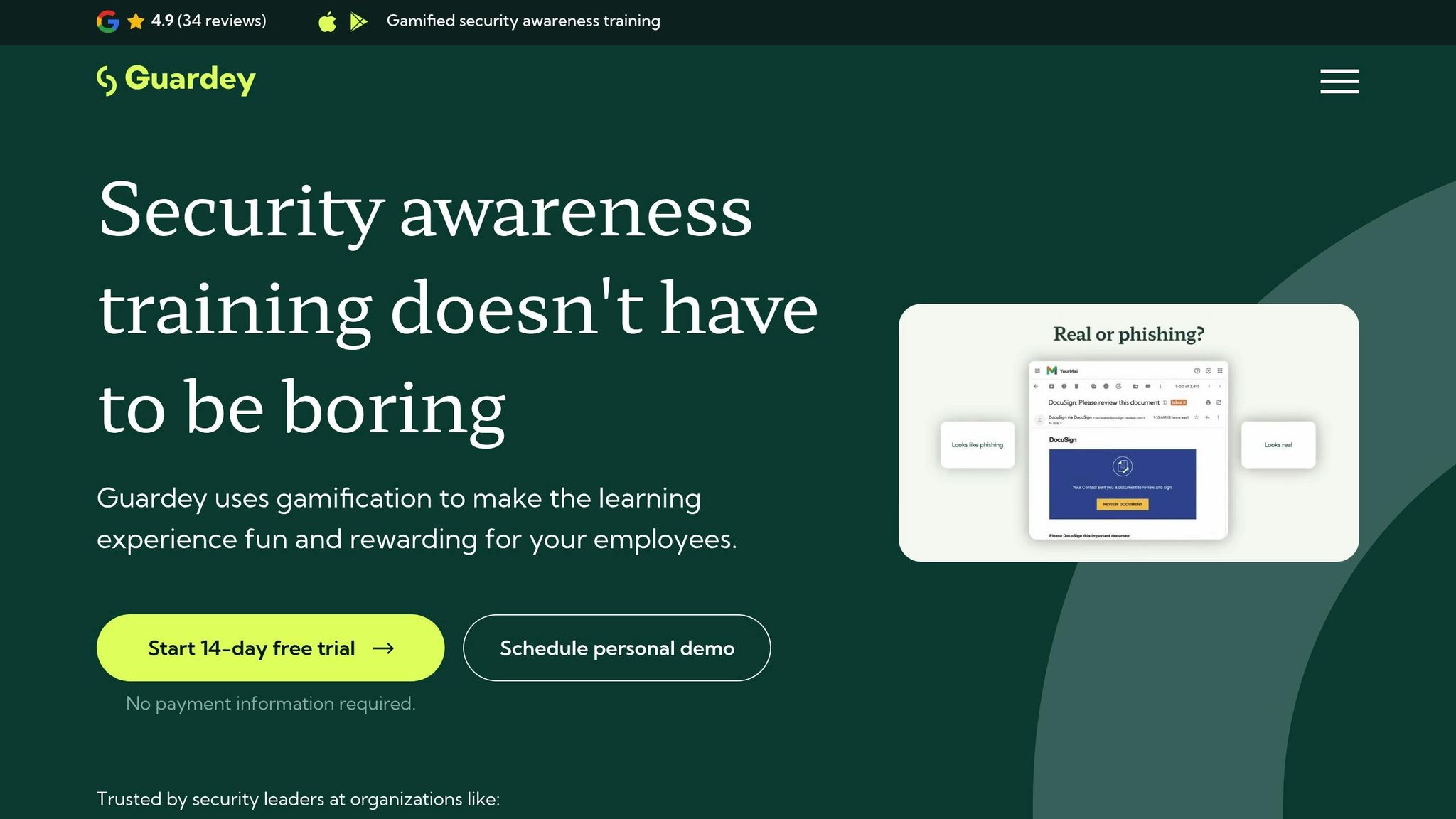
Guardey blends phishing simulations with weekly gamified awareness training, using quick challenges and leaderboards to encourage lasting behavioral changes.
Realism of Phishing Simulations
Guardey provides a library of phishing templates for easy simulation setups, along with advanced spear phishing tests that incorporate targeted social engineering tactics.
In one example, IT Manager Marcel Versluis shared how he used Guardey to run a phishing simulation based on a Christmas gift voucher – something his company sends every year. The results were eye-opening, as several employees clicked on the phishing link and even shared personal information. As Versluis explained:
"Together with the Guardey team, we came up with an email centered around a Christmas gift voucher that we send out every year… It turns out that quite a few employees clicked the phishing link and even entered personal data." – Marcel Versluis, IT Manager
Guardey’s real-time dashboard allows administrators to track the success of these simulations by monitoring email opens, link clicks, and data submissions. To encourage proactive security habits, the platform also rewards users with points for reporting both simulated and real phishing attempts. Alongside its robust simulation tools, Guardey stands out for its flexible pricing and quick setup.
Pricing and Scalability
Guardey’s transparent pricing and scalability make it accessible for a variety of organizations. The platform offers a 14-day free trial without requiring a credit card, making it easy for companies to explore its features. With a setup process that takes just minutes and training available in over 10 languages, Guardey is designed to accommodate international teams effortlessly. Boasting a 4.9/5 rating from 34 reviews, it has proven effective, even for organizations that might prefer video-based training. For instance, one company saw an 84% improvement in security awareness scores within just a few weeks of using Guardey’s gamified approach.
9. PhishingBox
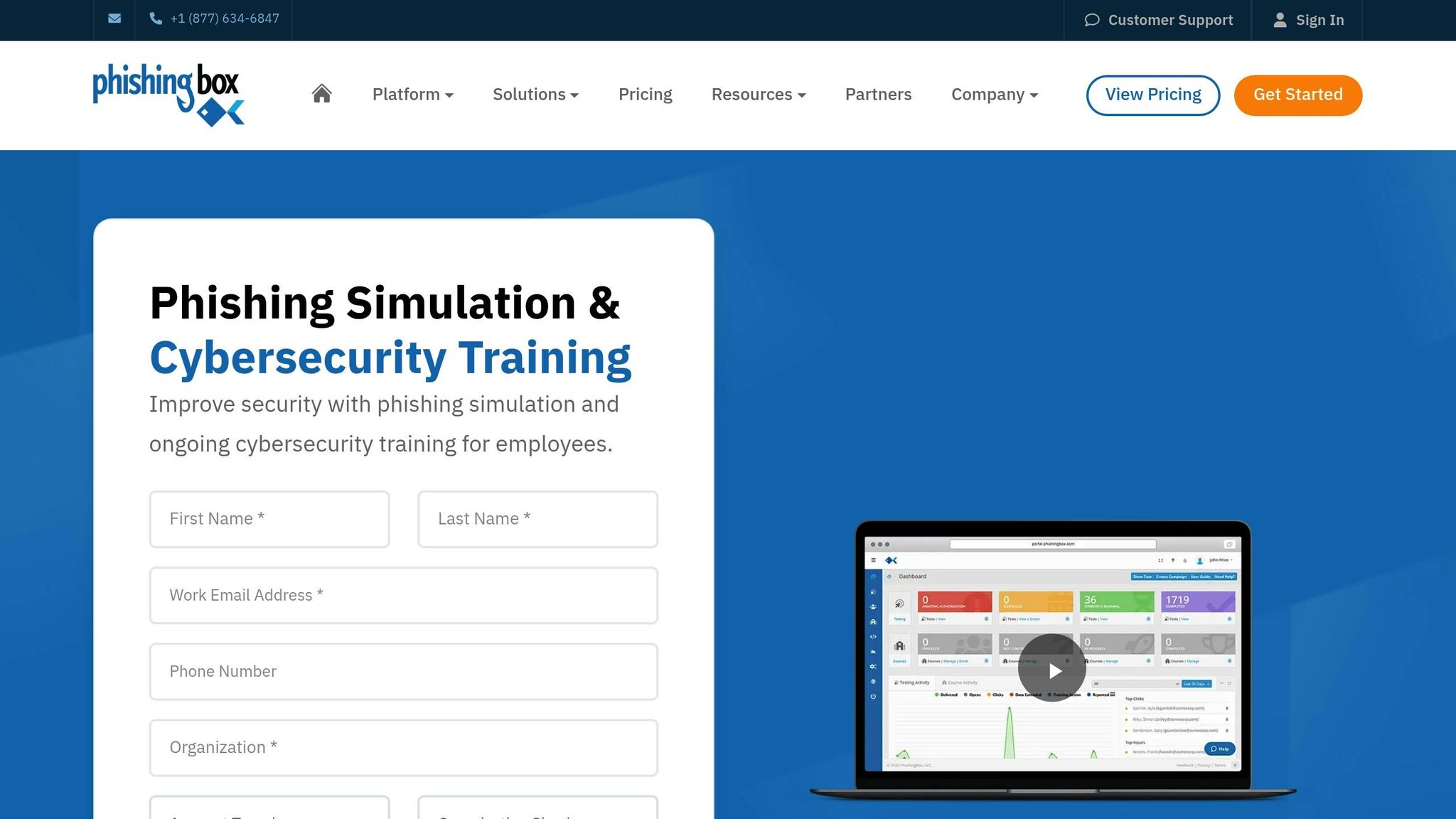
PhishingBox serves a global user base of 2,849,948 individuals, offering a browser-based platform equipped with a dynamic template library. These templates are fully customizable to reflect emerging real-world threats, keeping simulations relevant and effective.
Realism of Phishing Simulations
PhishingBox takes realism seriously, focusing on user engagement and actionable insights. It calculates a Net Reporter Score (NRS) to measure how effectively employees report phishing attempts. The platform also features the KillPhish™ email plugin, a Microsoft Add-on that scans emails and highlights potential threats in real time. This tool empowers employees to make informed decisions when assessing their inboxes.
If an employee falls for a phishing simulation, the platform’s SCORM-compliant Learning Management System (LMS) steps in automatically, delivering remediation training tailored to the failure. Additionally, the Security Inbox allows security teams to examine reported emails, analyze their threat characteristics, and send automated responses to reinforce employee learning. This approach ensures simulations feel authentic while seamlessly integrating into the broader security framework.
Integration with Existing Tools
PhishingBox is designed to work with the tools organizations already use. It integrates with SSO, CRM, HRIS, and LMS systems through its API. The KillPhish™ Microsoft Add-on embeds directly into email clients, making it easy for employees to report suspicious emails on the spot. For organizations with specific compliance needs, PhishingBox supports hosting in either U.S. or E.U. data centers, ensuring GDPR requirements are met. It also accommodates multi-client access, making it a versatile option for businesses of various sizes.
Pricing and Scalability
PhishingBox offers flexible pricing plans, making it accessible for organizations of all sizes. Setting up an account takes just 2–3 hours, and launching campaigns afterward is incredibly efficient, requiring only about 10 minutes.
- Standard Plan: $82.50/month for 50 seats
- Professional Plan: $119.62/month (includes LMS and API access)
- Enterprise Plan: $156.75/month (adds advanced features like Callback Phishing and KillPhish AI)
For those opting for annual billing, there’s a 20% discount compared to monthly payments. Alternatively, email-based pricing is available, starting at $1.75 per email for 600 emails annually, with rates dropping to $0.56 per email for 24,000 emails.
Leslie C., an IT Director, shared their experience:
"PhishingBox is a great tool to teach end users how to recognize Phishing and Spam emails. It’s easy to use and cost-effective."
PhishingBox combines ease of use, scalability, and affordability, making it a practical solution for organizations looking to strengthen their defenses against phishing threats.
10. uPhish by Usecure
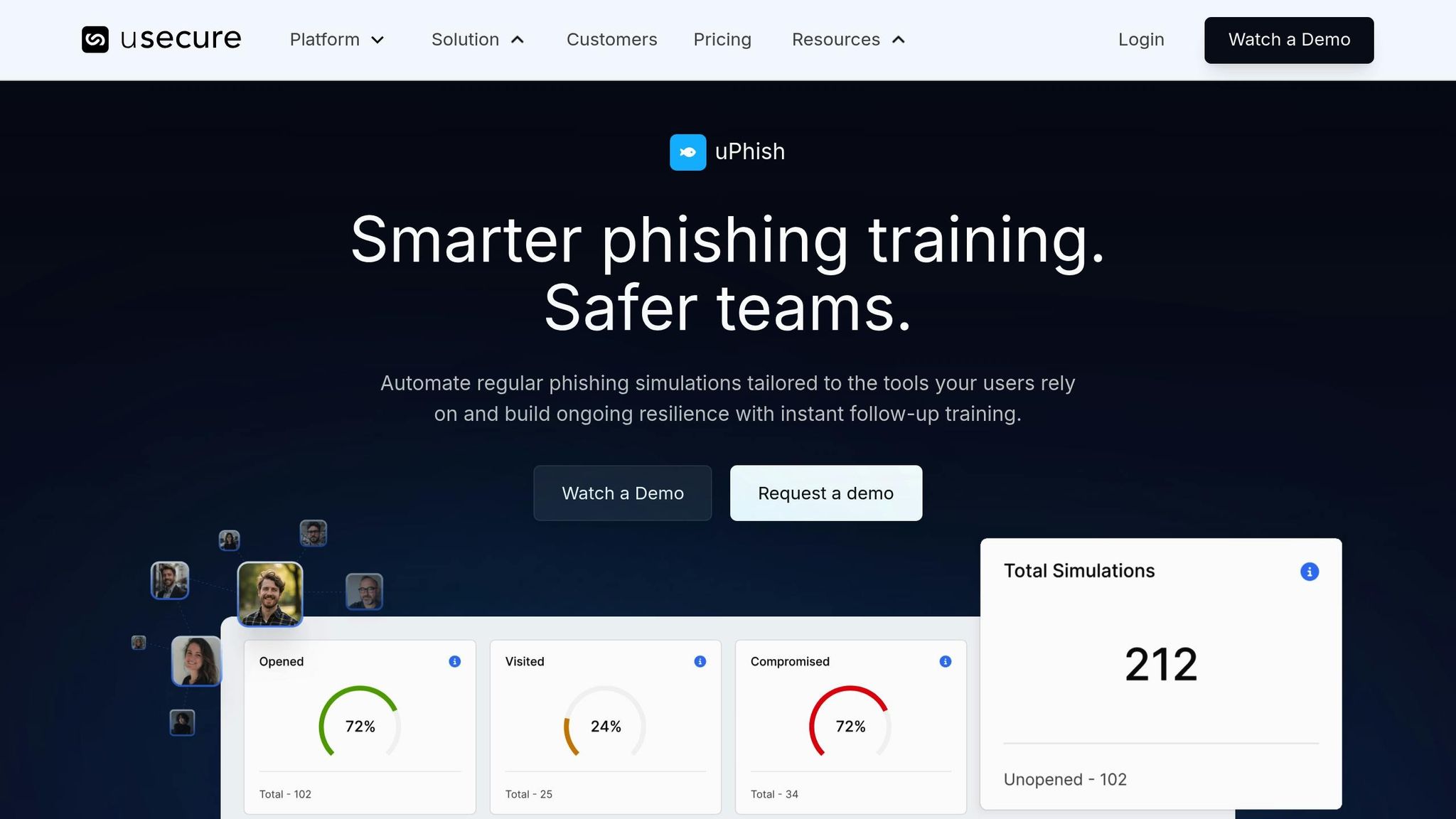
uPhish by Usecure is a phishing defense tool that combines realistic attack simulations with automated training workflows. Designed as a cloud-based solution, it’s ideal for organizations looking to strengthen security without adding extra administrative workload.
Realistic Phishing Simulations
uPhish offers an extensive library of templates that mimic trusted brands and services, creating simulations that feel authentic. Each simulation includes both a phishing email and a matching landing page, testing how employees respond throughout the entire attack process. The platform tracks key metrics – such as "opened", "clicked", and "compromised" rates – in real time to gauge employee vulnerability. For businesses dealing with more advanced threats, uPhish allows custom templates that imitate internal communications, like HR or IT messages. This feature reflects the reality that over 90% of cyber-attacks begin with phishing.
The AutoPhish feature takes this a step further by automating regular simulations. Instead of occasional exercises, employees are exposed to evolving phishing threats on an ongoing basis, ensuring consistent learning and readiness.
Intelligent Automation for Training
While it doesn’t explicitly call itself AI-driven, uPhish uses intelligent automation to deliver personalized training at scale. A quick 10-minute analysis across 12 security areas generates a custom 12-month training plan tailored to each employee’s specific weaknesses. With the AutoEnrol feature, employees receive monthly bite-sized training courses that adapt based on their individual risk profiles. If someone fails a simulation, they’re immediately enrolled in targeted "Phishing Awareness" courses, creating a seamless loop between testing and education.
Seamless Integration with Other Tools
uPhish works hand-in-hand with Usecure’s uLearn platform, enabling automatic training enrollment without requiring manual input. Its reporting tools provide detailed insights into user and departmental performance, helping security teams identify and address risks effectively. While users appreciate the platform’s intuitive interface, some note that customization can be time-intensive.
Scalability and Pricing
uPhish is designed to minimize technical effort while delivering effective phishing campaigns. Pricing details are available upon request. Its cloud-based infrastructure supports organizations of all sizes, scaling efficiently without adding administrative complexity. The platform’s structured "Evaluate – Educate – Simulate – Report" model ensures a systematic approach to improving employee security habits over time.
Comparison Table
Here’s a breakdown of 10 phishing simulation tools, evaluated for simulation quality, adaptability, integrations, scalability, and pricing.
Both KnowBe4 and Proofpoint perform exceptionally well in enterprise environments. They offer extensive template libraries and integrate deeply with other systems, though their AI is more focused on detecting threats than tailoring simulations to individual users. Hoxhunt stands out with cutting-edge simulations, including deepfakes and QR code phishing, combined with adaptive difficulty levels for a dynamic experience. Meanwhile, Cofense PhishMe excels at turning user-reported phishing attempts into actionable insights for Security Operations Centers (SOC). For teams with technical expertise, Gophish provides a budget-friendly, open-source option.
For mid-sized organizations, PhishingBox ($16.50–$31.25 per user/year) and uPhish offer reliable performance without the complexity of enterprise-grade platforms. Guardey takes a different approach, focusing on engagement through weekly gamified challenges and leaderboards, earning high marks for its interactive design. Sophos Phish Threat is an excellent choice for organizations already invested in the Sophos ecosystem, offering over 500 customizable templates and seamless integration with Sophos Central. Below, the table simplifies the comparison of these tools to help you make an informed decision.
| Tool | Simulation Quality | AI/Adaptive Capabilities | Key Integrations | Best For | Pricing |
|---|---|---|---|---|---|
| KnowBe4 | Strong (Template-based) | AI Defense Agents (Detection) | M365, Azure AD, PhishER | Large Enterprises | $1.30–$3.25/user/month |
| Proofpoint | Strong (Role-based) | Limited (Library-driven) | Proofpoint Stack, Threat Intel | Regulated Industries | ~$18/user/year |
| Cofense PhishMe | High (Targeted) | Partial (Customization) | SIEM, SOAR, Triage/Vision | SOC & IR Teams | Quote-based |
| Hoxhunt | High (Deepfakes/QR) | High (Adaptive Difficulty) | M365, Azure, SOC Connectors | Human Risk Management | Quote-based |
| Infosec IQ | Medium/Strong | Partial (Automation) | Azure AD, LMS, APIs | Compliance-driven Orgs | $20/user/year (min $1,500) |
| Gophish | Variable (Manual) | None | REST API (Custom) | Tech-savvy Teams | Free |
| Sophos Phish Threat | Medium/Strong | Limited | Sophos Central, Outlook | Sophos Ecosystem Users | Quote-based |
| Guardey | Medium (Habit-focused) | None | Cloud-based, Simple Setup | Engagement-first Orgs | Quote-based |
| PhishingBox | Medium | None | API, LDAP, Database Sync | SMBs/Mid-market | $16.50–$31.25/user/year |
| uPhish (Usecure) | Medium | None | Cloud-based, uLearn | MSPs/Mid-market | Quote-based |
This comparison highlights the growing importance of tailored, continuous training in combating phishing threats. Data shows that comprehensive training programs can reduce phishing susceptibility by over 80% within a year. Solutions like Hoxhunt, which emphasize ongoing training, report phishing detection rates as high as 60%, compared to just 7% for quarterly training models. Selecting a tool that adapts to emerging threats like quishing, smishing, and vishing is crucial in today’s cybersecurity landscape. This underscores the need for tools that evolve alongside these ever-changing risks.
Conclusion
Phishing simulation tools have become a must-have for organizations looking to strengthen their cybersecurity defenses in 2025. With billions of phishing emails sent daily and a staggering 1,200% increase in AI-driven phishing campaigns , the threat is both widespread and sophisticated. These statistics highlight the pressing need for effective tools to combat such attacks.
The right simulation tool can transform employees from potential targets into a strong line of defense. Research shows that realistic simulations can lower employee susceptibility to phishing by as much as 70% when used consistently across multiple campaigns. By making security awareness second nature, these tools help organizations of all sizes protect themselves more effectively.
When choosing a tool, it’s crucial to consider your organization’s size, technical capabilities, and goals. For compliance-focused needs, platforms like Proofpoint or KnowBe4 offer robust, audit-friendly reporting. If you’re aiming to drive measurable behavioral changes, adaptive tools like Hoxhunt use gamification and AI to tailor difficulty levels. For teams with limited budgets but strong technical skills, open-source solutions like Gophish can be a good fit. Mid-sized organizations often find platforms like PhishingBox or uPhish strike the right balance between features and cost. With so many options available, every organization can find a tool that aligns with its specific risk profile.
The phishing threat landscape is constantly evolving, with attackers now using advanced tactics like deepfake videos, voice cloning, QR code phishing (quishing), and SMS phishing (smishing). Staying alert to these emerging threats is just as critical as deploying the right tools. For regular updates on phishing trends, AI-driven attacks, and practical cybersecurity tips, check out Cyber Detect Pro, a resource dedicated to helping you stay ahead of the curve.
FAQs
What should I look for when selecting a phishing simulation tool for my organization?
When selecting a phishing simulation tool, it’s essential to ensure it aligns with your organization’s specific needs and objectives. Opt for tools that provide a variety of realistic phishing scenarios – such as email, smishing, or even AI-driven attacks – to better prepare your team for potential threats. Customization is another important factor; being able to adapt templates and content to reflect your industry or workforce can make the training more relevant and impactful.
Look for tools that offer interactive training modules triggered immediately after an employee falls for a simulated phishing attempt. This approach helps reinforce learning in the moment. Additionally, robust analytics and reporting features, like tracking click rates and monitoring compliance, can give you valuable insights into the program’s effectiveness while helping you stay on top of regulatory requirements. Lastly, review the pricing structure carefully to ensure it fits within your budget and doesn’t come with hidden fees.
How does AI improve the effectiveness of phishing simulation tools?
AI is transforming phishing simulation tools by making them more realistic and tailored to mimic actual threats. These tools now use AI to craft highly convincing phishing emails, landing pages, and even deepfake voice or video elements. The result? Users get to experience the same level of sophistication found in real-world attacks, helping them build stronger defenses.
On top of that, AI evaluates user behavior – like how often they click on suspicious links or report phishing attempts – to assign risk scores and customize future simulations. This means training scenarios are specifically designed to address individual vulnerabilities, making the education process more relevant and effective.
AI also taps into threat intelligence feeds to keep simulations up-to-date with new attack methods, such as QR code phishing or voice spoofing. By staying one step ahead, this evolving strategy increases awareness, reduces risks, and gives businesses a clear picture of how their training efforts are paying off.
Why is ongoing training essential for reducing the risk of phishing attacks?
Keeping up with training is essential for staying ahead of constantly changing phishing tactics. Regular practice sharpens employees’ and individuals’ skills in spotting suspicious emails, links, or messages, which significantly cuts down the chances of falling victim to scams.
Research indicates that ongoing training can reduce phishing click-through rates by as much as 70% over time. This doesn’t just safeguard sensitive data – it also boosts overall cybersecurity awareness, helping create a safer digital environment for both businesses and individuals.